Saint Dominic de Guzman stands among the greatest figures in the history of the Catholic Church a humble, brilliant, and deeply compassionate Spanish priest whose vision of an educated, mobile, and preaching-focused religious order transformed Christianity’s response to heresy and intellectual challenge in the 13th century. As the founder of the Order of Friars Preachers universally known as the Dominican Order his legacy has shaped Catholic theology, education, and missionary work for more than eight centuries.
Profile Details
| Full Name | Domingo de Guzmán (Dominic de Guzman) |
| Born | August 8, 1170 |
| Died | August 6, 1221 |
| Birthplace | Caleruega, Old Castile, Kingdom of Castile (present-day Spain) |
| Nationality | Castilian (Spanish) |
| Occupation | Catholic Priest, Religious Founder, Preacher |
| Religion | Roman Catholic |
| Father | Felix de Guzmán |
| Mother | Blessed Jane (Juana) of Aza |
| Siblings | Antonio (elder brother, secular priest); Manes (younger brother, blessed) |
| Canonized | July 3, 1234, by Pope Gregory IX |
| Feast Day | August 8 |
| Patronage | Astronomers, natural scientists, the Dominican Republic, the falsely accused |
Early Life
Dominic de Guzman was born on August 8, 1170, in the small village of Caleruega, nestled in the ancient region of Old Castile in what is now northern Spain. He was born into a noble family of considerable local standing. His father, Felix de Guzmán, was the lord of the manor in Caleruega a man of honor and wealth in the village. His mother, Juana (later beatified by the Church as Blessed Jane of Aza in 1828), was renowned throughout the region for her deep piety, her concern for the poor, and her saintly character. It was said that before Dominic’s birth, his mother had a prophetic dream in which a dog leapt from her womb carrying a flaming torch, setting the world on fire a vision later interpreted as foreshadowing her son’s mission to set the world alight with the Gospel.
Dominic was named after Dominic of Silos, a Benedictine saint whose abbey the Benedictine Abbey of Santo Domingo de Silos lay just a few miles north of his birthplace. His upbringing in such a deeply religious household shaped him from his earliest years. He was known as a remarkably devout and compassionate child. When he was seven, his education was entrusted to his maternal uncle, a priest, who oversaw his early formation in faith and letters.
His compassion expressed itself vividly during his student years: witnessing widespread famine and suffering around him, the young Dominic sold his books treasured resources for a scholar to help the poor. He famously said, “How can I study from these dead skins when men are dying of hunger?”
His brothers too were distinguished men: his elder brother Antonio became a secular priest who distributed his wealth to the poor and spent his life serving the sick in a hospital. His younger brother Manes later became a friar in the Order Dominic founded and is himself venerated as a blessed.
Education
At the age of fourteen, Dominic was sent to the school at Palencia one of the few prestigious centers of higher learning in Spain at the time. There he studied liberal arts for six years, followed by four years of theology. He excelled in both disciplines, demonstrating a formidable intellectual capacity alongside his spiritual depth. His companions at Palencia noted his unusual devotion: he spent his nights in prayer, rarely sleeping, and was known to weep for sinners and for the suffering of others.
Around 1196, at approximately age 24, Dominic was ordained a priest and joined the community of canons regular attached to the Cathedral of Osma under the Augustinian Rule. He eventually became sub-prior assistant to the prior of the cathedral chapter, serving under Bishop Diego of Osma, who became one of the most important figures in Dominic’s spiritual and apostolic formation.
Career
Dominic’s public mission began in earnest in 1203, when Bishop Diego of Osma was dispatched on a royal diplomatic mission to Denmark to negotiate a royal marriage. He took Dominic with him as his companion. During their travels through southern France, Dominic and Diego encountered the Albigensian (Cathar) heresy a dualistic religious movement that had spread widely in the Languedoc region and was actively undermining the Catholic faith among the local population. This encounter was a turning point in Dominic’s life.
Witnessing the effectiveness of the Cathars’ austere lifestyle and persuasive preaching in stark contrast to the wealth and formality of the Church’s existing representatives Dominic and Diego adopted a radically different approach to their evangelization: traveling on foot in poverty, preaching humbly and personally, engaging in genuine dialogue with those who had been led astray. This apostolic method proved far more effective than the confrontational, top-down approach previously employed.
In 1206, Dominic established a convent for women at Prouille an institution designed to protect Catholic women from heretical influence and to provide refuge for women converted from the Cathar faith. This community became the first house of what would grow into the Dominican Second Order (Dominican nuns).
As his preaching mission expanded, Dominic gathered a small group of like-minded followers. By 1215, he had established a house in Toulouse, France a formal community of dedicated preachers living under religious rule. In that year, he accompanied Bishop Fulk of Toulouse to the Fourth Lateran Council in Rome, where he sought papal approval for a new religious order. Pope Innocent III, while initially cautious, encouraged Dominic to adopt the Rule of an existing order and return for formal approval.
On December 22, 1216, Pope Honorius III Innocent’s successor granted formal papal approval to the new Order of Friars Preachers. The Dominican Order was officially born. It was the first religious order specifically dedicated to preaching and teaching, combining the contemplative life of monastic orders with the active, mobile apostolate needed to address the spiritual crises of the rapidly growing cities of medieval Europe.
Dominic’s organizational genius was evident in his vision for the Order. He placed his two principal houses near the great universities of Paris and Bologna the intellectual centers of medieval Europe deliberately ensuring that Dominican friars would be rooted in theological scholarship. He decreed that each Dominican house should maintain a school of theology, establishing an educational tradition that would later produce giants of Western thought such as Saint Thomas Aquinas and Saint Albert the Great.
On August 15, 1217, in one of history’s most counterintuitive strategic moves, Dominic dispersed his small band of 17 companions across Europe sending them to Paris, Spain, and Rome, while he himself traveled to Bologna and Rome. This bold act of dispersal, which appeared reckless to outside observers, proved visionary: within decades, the Dominican Order had spread to hundreds of houses throughout Europe and beyond.
Dominic spent his final years traveling ceaselessly throughout Europe to maintain contact with his expanding brotherhood, organizing chapters, and founding new houses. He made his headquarters in Rome and, in 1219, was invited by Pope Honorius III to take up residence at the ancient Roman basilica of Santa Sabina, which became the Order’s headquarters in Rome a role it fulfills to this day.
Awards & Honors
- Canonized as a Saint by Pope Gregory IX on July 3, 1234 just thirteen years after his death
- Feast Day celebrated on August 8
- Patron Saint of astronomers and natural scientists
- Patron Saint of the Dominican Republic (the country is named after him)
- The Order of Friars Preachers (Dominicans) recognized as one of the four great mendicant orders of the Catholic Church
- The rosary tradition credited in significant part to Dominic and the Dominican Order
Personal Life & Character
Saint Dominic was renowned for his extraordinary character. He was described by his contemporaries as always joyful, warm, and community-minded during the day full of humor and charity toward his brothers and associates while spending his nights in intense personal prayer and penance. He wore a hair shirt beneath his habit, slept on bare boards, and rarely allowed himself physical comfort. He owned nothing personally, perfectly embodying the poverty he preached.
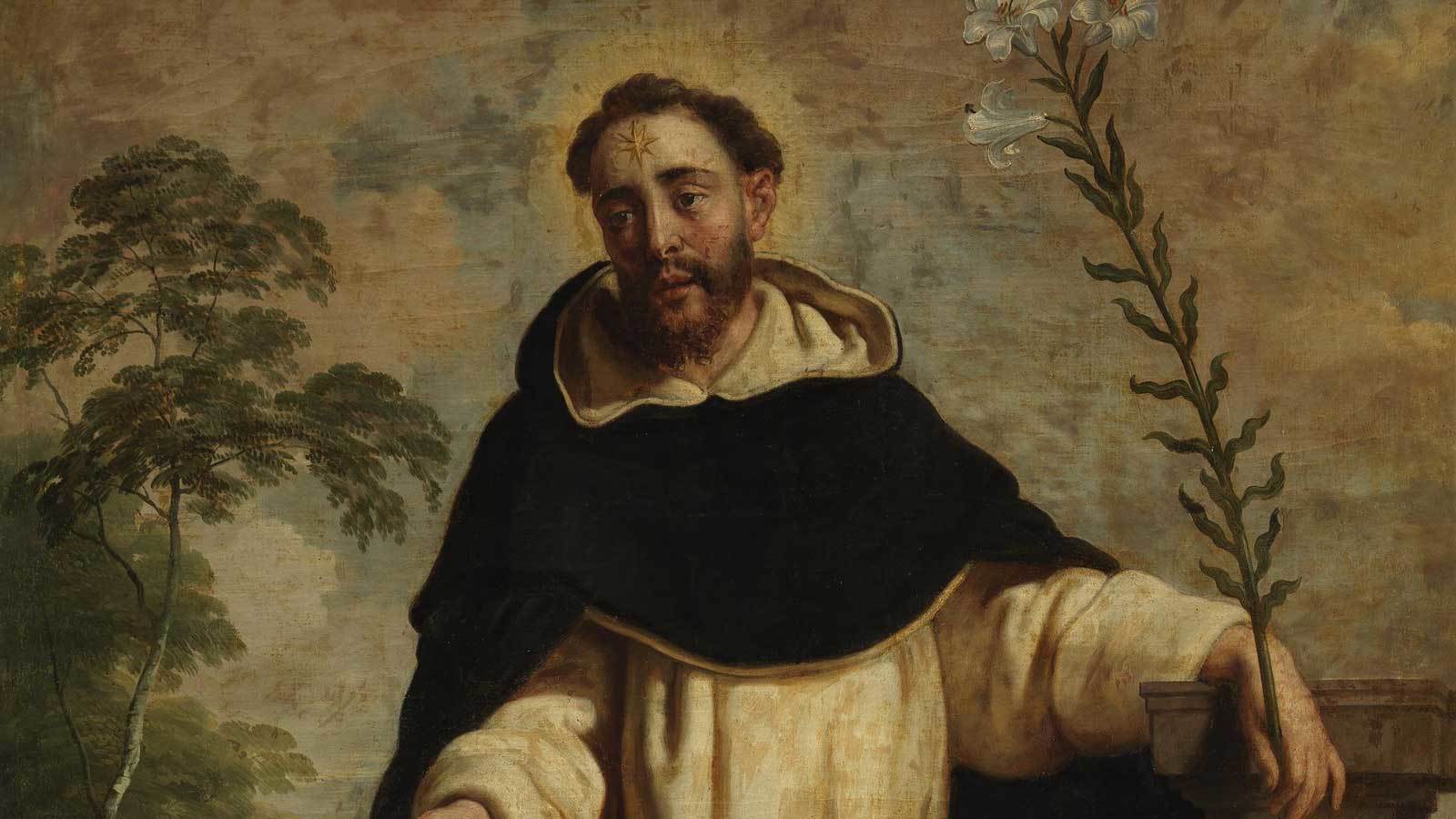
He was known for weeping in prayer particularly for sinners and for those suffering in purgatory and his tears were said to be a constant sign of his compassionate intercession for others. He is frequently depicted in Catholic iconography holding a lily (symbol of purity) or a dog carrying a torch (referencing his mother’s prophetic dream).
One of the most celebrated aspects of his legacy is his association with the rosary. According to Dominican tradition, in 1208 at the church at Prouille, Dominic experienced a vision of the Blessed Virgin Mary who gave him the rosary though historians note that rosary beads were already in use and that Dominic and the Dominicans were responsible for greatly popularizing and spreading this form of prayer.
Dominic died on August 6, 1221, in the Dominican convent in Bologna, Italy in a cell that was not his own, surrounded by his friars, having never acquired personal property of any kind. He died as he had lived: in perfect poverty, perfect charity, and perfect devotion.
Legacy & Impact
The legacy of Saint Dominic de Guzman is immeasurable. The Dominican Order he founded has, for over 800 years, been one of the most intellectually and spiritually productive institutions in Christian history. Its members include Saint Thomas Aquinas (the greatest theologian of the medieval Church), Saint Albert the Great, Saint Catherine of Siena, Saint Rose of Lima, and Fra Angelico, among many others.
The Dominican Republic the Caribbean nation and its capital Santo Domingo are named in his honor. Countless churches, schools, universities, and convents worldwide bear his name. The city of San Domingo (now known as San Fernando) in the Philippines, and the Philippine prelature of Batanes-Babuyanes, count him among their patron saints.
Net Worth
As a religious figure who embraced voluntary poverty, Saint Dominic de Guzman possessed no personal wealth or property. The concept of net worth is entirely inapplicable to his life and mission. He gave away what little he had, owned nothing, and died without personal possessions in deliberate imitation of the apostolic poverty of Jesus Christ and his disciples.
FAQs
Who is Saint Dominic de Guzman?
Saint Dominic de Guzman (1170–1221) was a Castilian Catholic priest and the founder of the Order of Friars Preachers the Dominican Order. He is one of the most significant saints in the history of the Roman Catholic Church.
What is Saint Dominic known for?
He is known for founding the Dominican Order in 1216, for his preaching against the Albigensian heresy in southern France, and for his association with the popularization of the rosary.
Where was Saint Dominic born?
He was born in Caleruega, in the region of Old Castile, Spain, in approximately 1170.
When was Saint Dominic canonized?
He was canonized by Pope Gregory IX on July 3, 1234 just thirteen years after his death in 1221.
What is the Dominican Order?
The Dominican Order formally the Order of Friars Preachers (O.P.) is a Roman Catholic mendicant religious order founded by Saint Dominic in 1216. It is dedicated to preaching, teaching, and the contemplative life, and has produced many of the Church’s greatest theologians and saints.
Is the Dominican Republic named after Saint Dominic?
Yes. The Dominican Republic and its capital city Santo Domingo are both named in honor of Saint Dominic de Guzman.
Conclusion
Saint Dominic de Guzman’s life was one of extraordinary spiritual intensity, intellectual brilliance, and apostolic creativity. In a world torn by heresy, poverty, and spiritual confusion, he forged a new kind of religious life one that combined deep prayer with rigorous scholarship, personal poverty with effective preaching, and communal life with universal mission. More than eight centuries after his death, the Order he founded continues to preach, teach, and serve across every continent. His feast is celebrated every August 8, and his memory lives on in the hearts of millions who bear his name, pray in his honor, and follow in his apostolic footsteps.