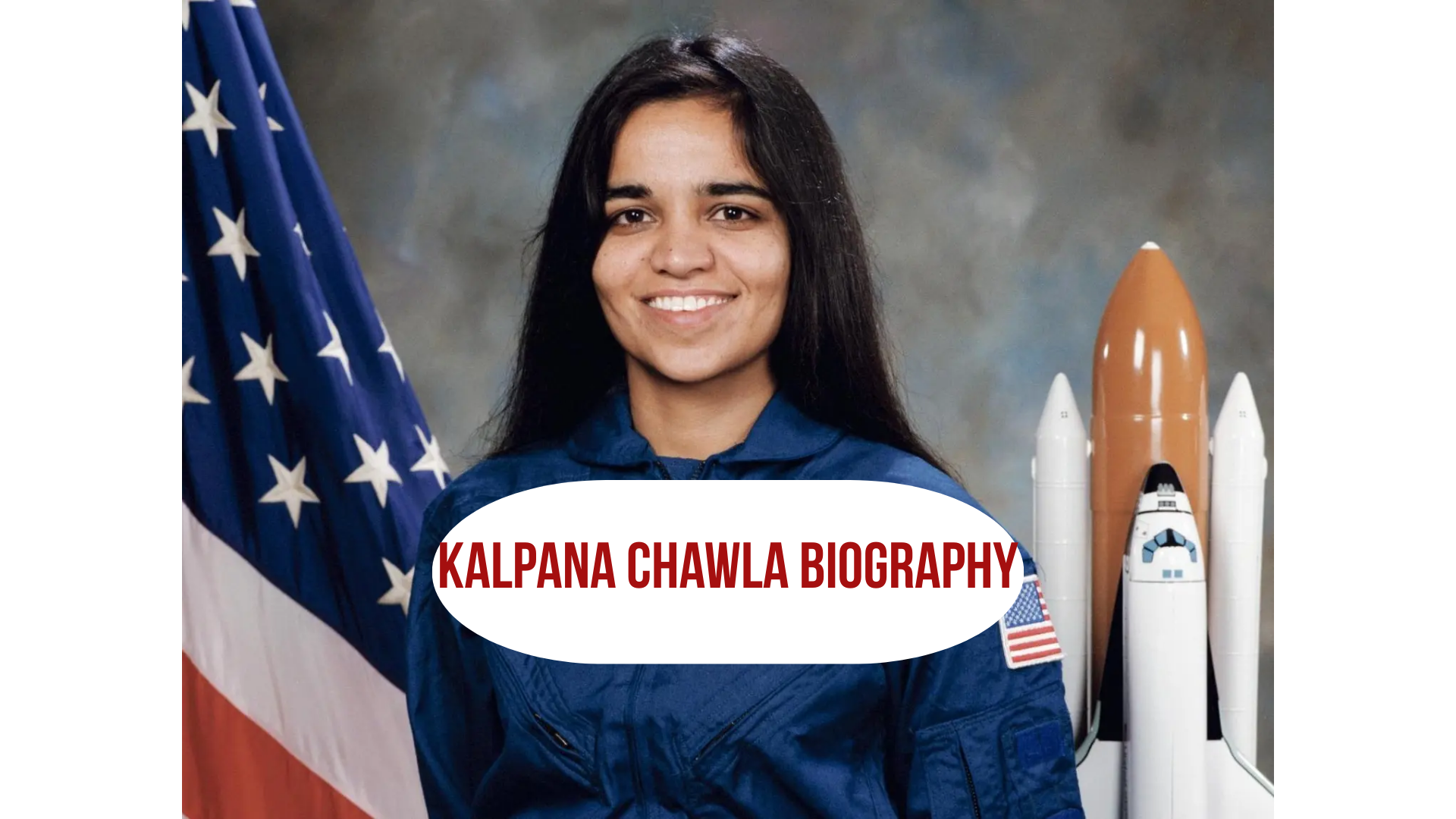
The story of Kalpana Chawla is one of courage, brilliance, and unwavering determination. She made history as the first woman of Indian origin to travel into space, inspiring millions across the globe.
From a small town in India to the vastness of outer space, her journey represents the triumph of dreams over limitations.
Kalpana Chawla’s biography is not just about space missions; it is about passion for aerospace engineering, dedication to science, and the resilience of a woman who broke barriers in a male-dominated field. Her life remains a powerful symbol of ambition and perseverance.
Quick Facts
| Full Name | Kalpana Chawla |
| Born | March 17, 1962 |
| Age | 40 years (at the time of death in 2003) |
| Death | February 1, 2003 |
| Birthplace | Karnal, Haryana, India |
| Nationality | Indian-American |
| Occupation | Astronaut, Aerospace Engineer |
| Parents | Banarasi Lal Chawla (Father), Sanjyothi Chawla (Mother) |
| Spouse | Jean-Pierre Harrison |
| Children | None |
Early Life
Kalpana Chawla was born on March 17, 1962, in Karnal, Haryana, India. Growing up in a modest household, she displayed a deep fascination with flying machines and the sky from an early age. While other children played traditional games, Kalpana would watch airplanes and sketch aircraft designs.
Her father, Banarasi Lal Chawla, and mother, Sanjyothi Chawla, encouraged her education. Despite societal expectations for women at that time, Kalpana was determined to pursue engineering — a field then dominated by men.
She completed her schooling in Karnal and later enrolled at Punjab Engineering College, earning a degree in Aeronautical Engineering in 1982. Her academic excellence set the foundation for her future success.
Higher Education and Move to the United States
Determined to deepen her knowledge, Kalpana moved to the United States to pursue higher education. She earned a Master’s degree in Aerospace Engineering from the University of Texas at Arlington in 1984. Later, she completed a second Master’s and a Ph.D. in Aerospace Engineering from the University of Colorado Boulder.
Her academic research focused on computational fluid dynamics and aircraft simulation. Her expertise eventually led her to work with NASA-affiliated research programs.
In 1991, she became a naturalized U.S. citizen — a significant milestone in her journey toward becoming an astronaut.
Career at NASA
Kalpana Chawla joined NASA in 1988 as a researcher at Ames Research Center. Her work involved aerodynamic optimization and computational modeling.
In 1994, she was selected as an astronaut candidate. This marked a historic moment, as she became the first woman of Indian origin to join NASA’s astronaut corps.
First Space Mission – STS-87
Kalpana first flew in space aboard STS-87 in 1997 on the Space Shuttle Columbia. During this mission, she operated robotic arms and conducted various scientific experiments. The mission lasted over 15 days and orbited Earth 252 times.
Her performance demonstrated her technical skill and composure under pressure.
Second Space Mission – STS-107
Kalpana Chawla’s second mission was aboard STS-107, once again on the Space Shuttle Columbia.
Launched on January 16, 2003, STS-107 was a dedicated science mission that conducted over 80 experiments in microgravity. Kalpana served as a mission specialist and played a crucial role in scientific research onboard.
The crew included seven astronauts from diverse backgrounds, symbolizing international cooperation in space exploration.
Columbia Tragedy
On February 1, 2003, tragedy struck as Space Shuttle Columbia disintegrated upon re-entry into Earth’s atmosphere. The accident was caused by damage to the shuttle’s thermal protection system during launch.
All seven crew members, including Kalpana Chawla, lost their lives in the disaster. The incident deeply shocked the world and led to major changes in NASA’s safety protocols.
Kalpana’s final message reflected her passion: she once said that when you look at the stars, you feel connected to the universe.
Achievements and Honors
Kalpana Chawla received numerous posthumous honors, including:
- Congressional Space Medal of Honor
- NASA Space Flight Medal
- NASA Distinguished Service Medal
Several institutions, scholarships, and awards have been named after her in India and the United States. Schools, hostels, and even satellites bear her name.
Her legacy continues to inspire young women in STEM fields worldwide.
Personal Life
Kalpana married Jean-Pierre Harrison, a flying instructor and aviation author. The couple shared a passion for aviation and exploration.
Despite living abroad, Kalpana maintained strong ties to India. She frequently encouraged Indian students to pursue careers in science and engineering.
Legacy and Impact
Kalpana Chawla’s biography is more than a life story — it is a blueprint for dreaming big. She broke cultural, gender, and geographical barriers to achieve excellence in aerospace engineering.
Her life teaches us:
- Never limit your dreams
- Education is the key to opportunity
- Determination can overcome societal barriers
- Passion fuels success
She remains a role model for aspiring astronauts, engineers, and young girls worldwide.
Inspirational Quotes by Kalpana Chawla
- “The path from dreams to success does exist.”
- “Follow your dreams. They do know the way.”
- “When you look at the stars and the galaxy, you feel that you are not just from any particular piece of land.”
Frequently Asked Questions (FAQs)
1. Who was Kalpana Chawla?
Kalpana Chawla was an Indian-American astronaut and aerospace engineer, the first woman of Indian origin to travel to space.
2. When was Kalpana Chawla born?
She was born on March 17, 1962, in Karnal, Haryana, India.
3. How did Kalpana Chawla die?
She died on February 1, 2003, in the Space Shuttle Columbia disaster during re-entry.
4. How many times did Kalpana Chawla go to space?
She flew in space twice — STS-87 (1997) and STS-107 (2003).
5. What is Kalpana Chawla famous for?
She is famous for being the first woman of Indian origin in space and for her contributions to aerospace science.
6. What awards did she receive?
She received the Congressional Space Medal of Honor, NASA Space Flight Medal, and NASA Distinguished Service Medal.
Conclusion
The biography of Kalpana Chawla is a testament to human courage and ambition. From Karnal to outer space, her journey continues to inspire generations. Though her life ended tragically, her legacy lives on in classrooms, research centers, and the hearts of dreamers worldwide.
Kalpana Chawla proved that dreams have no boundaries — not even the sky.